Politics doesn’t belong in school. We have probably heard this sentence many times, and in one respect it makes sense. A teacher shouldn’t try to persuade children whom to vote for or present their own opinion as the only right one. But school is not a closed bubble. Children live in the same world as we do. They hear their parents’ conversations, catch the news and increasingly come across current events on social media.
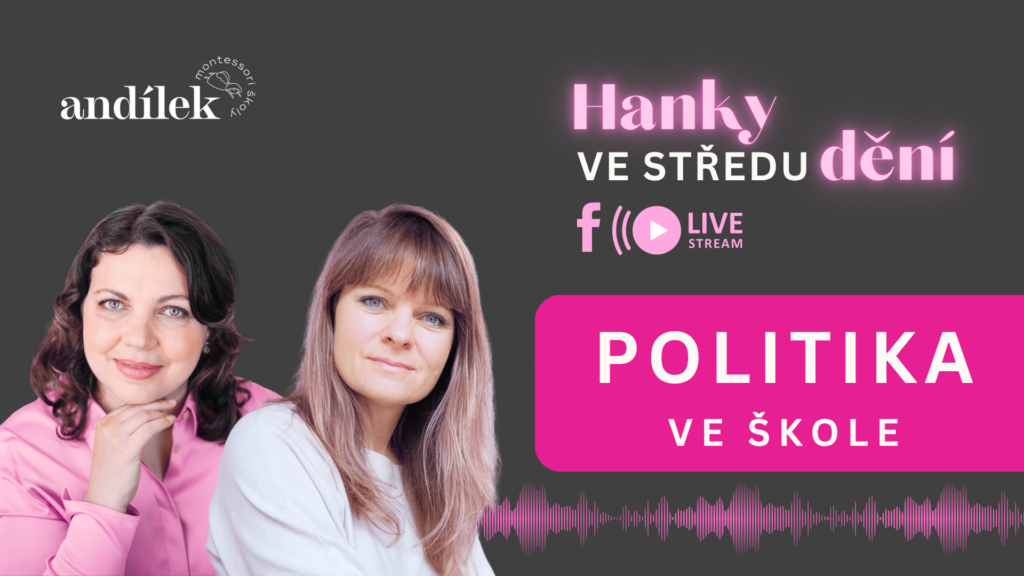
This is exactly what Hanka Trejklová and Hanka Slabá talk about in the Hanky ve středu dění podcast. Where does explaining end and persuading begin? Should a teacher share their political views in front of children? And what can we do to help children find their own way in the world around them?
Children encounter the news earlier and earlier
In the past, children came across the news mainly at home, from the television, radio or newspapers. Today, all they need to do is open a phone. Even a younger child can come across news about war, elections or protests without understanding exactly what they are watching and why it is happening.
As children grow older, the questions multiply. They want to know who makes decisions, why people disagree or what is fair. Adolescents are already forming their own views, and these may not match the opinions of their parents or teachers. Rather than trying to push political topics out of school, it makes more sense to learn how to talk about them with children in a way that suits their age.
Politics yes, persuasion no
At school, we can talk about elections, democracy, the media, wars, protests or human rights. But a teacher doesn’t need to tell children whom they vote for or which political party they think is best. Their job is not to raise supporters of their own opinions in the classroom.
That doesn’t mean, however, that a school has no values. Children don’t need to know whom their teacher votes for, but they should know what their school stands for. Respect for others, freedom, responsibility and cooperation are not party politics. They are part of how we live together at school every day.
Instead of right answers, let’s ask questions
If we want to teach children to think critically, we can’t simply hand them a list of correct opinions. They need to compare information, look for connections, ask where information comes from and consider other people’s arguments. A teacher doesn’t need to know the answer to everything. Sometimes they achieve much more by asking a good question.
In the podcast, the two Hankas give an example from working with adolescents on the topic of communism. The students thought about what they would have to do if they wanted to gain complete power over a state. Step by step, they arrived at controlling the media, limiting the independence of the courts and working with fear. Instead of memorising terms, they discovered for themselves how someone can gain, consolidate and abuse power.
We need critical thinking beyond the textbook too
Today, children need to recognise the difference between fact and opinion, check their sources and notice manipulation. If they practise these skills on topics they actually encounter, they understand much more easily why they need them. Current events don’t have to disrupt learning. On the contrary, they can open up topics that truly matter to children.
What’s more, children don’t encounter power, injustice or manipulation only in the news. They experience them among themselves too. When someone in the class uses their advantage against another, we can either simply resolve the situation, or use it for a conversation about boundaries, responsibility and respect.
Let’s teach children to think, not to think like us
So perhaps the question is not whether politics belongs in school. What matters more is how we talk about it with children. We can offer them context, ask questions, discuss and make room for different perspectives. At the same time, we should be careful not to use our authority to decide which opinion children should take home.
After all, we don’t want children to automatically adopt the views of their parents or teachers. We want them to learn to ask questions, look for information, think about it and gradually form their own opinion. So let’s not teach them what to think. Let’s teach them how to think.
You can watch the full conversation between Hanka Trejklová and Hanka Slabá in the Hanky ve středu dění podcast here (in Czech):