What is actually normal? A classroom brings together children who think, learn and react in different ways. Some have ADHD, dyslexia, dysgraphia or autism spectrum disorder, others have no diagnosis at all, yet still need more support in a particular area.
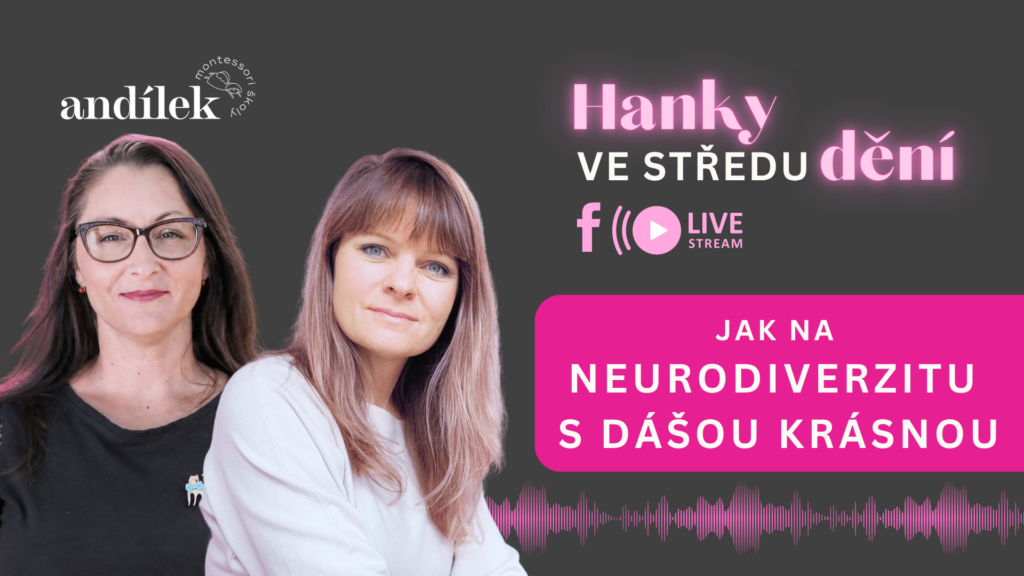
In the Hanky ve středu dění podcast, Hanka Trejklová and special education teacher Dáša Krásná focus on neurodiversity in the classroom. They talk about their experience from Andílek’s school counselling centre, working with parents and why we shouldn’t automatically see difference as a problem.
Every child carries their own “backpack”
Neurodiversity is based on a simple idea: not all human brains work the same way. A different way of thinking or learning therefore doesn’t have to be seen only as a deviation that needs to be corrected. Some children are born with a developmental difference, others are affected by their environment, a change of school, a language barrier or other experiences they bring with them into the classroom.
Instead of looking for the line between “normal” and “different”, it makes more sense to look at the particular child. What are they good at? Where do they struggle? How do they respond to their environment and what could help them? A school can build support on exactly these questions, without excluding the child from the group because of their difficulties.
Support doesn’t happen only at school
As a special education teacher, Dáša Krásná works not only with children, but also with their parents and teachers. Each of them sees the child in a slightly different environment. The school may notice difficulties with learning or concentration, while parents know the situations the child does or doesn’t manage at home. Only when both sides talk to each other can they find a way that really helps the child.
Sometimes parents also need support in accepting that their child needs something different from a classmate. It doesn’t mean something is wrong with the child. It simply means they learn or function differently. Instead of asking what kind of child we would like to have, we can then ask what this child is really like and what they need.
School is not a repair shop for children
The conversation includes an apt comparison: sometimes a parent comes to a specialist almost as if to a car repair shop. Something is broken, so “fix” the child and give them back. But neither the school nor the special education teacher fixes children.
A child doesn’t simply “grow out” of ADHD, dyslexia or another form of neurodivergence. But they can learn to understand themselves better, recognise their strengths and adopt strategies that help them manage the areas where they struggle. The purpose of support is therefore not to reshape a child to fit an idea of the norm, but to help them find a way to function well with their needs.
We can talk about difficulties without labels
The language we use to talk about children also plays a big role. When we notice difficulties with reading, attention or behaviour, we don’t have to label the child as a problem. We can simply describe what we observe and work with the parents to find what would help.
We can model the same approach for children. With younger children, stories work well, for example, helping them understand that someone reads more slowly, communicates differently or reacts to situations in their own way. Children learn that difference is no reason to look down on someone.
We don’t need children to be the same
A safe environment doesn’t create itself. A school has to work consciously on how children accept differences among themselves, how teachers talk about differences and whether a child knows where to turn when they need help. Parents’ attitudes matter just as much. When a child sees from an early age that the people around them accept others with different abilities and needs, it is easier for them to accept their own difference later on.
Neurodiversity reminds us of something we should perhaps take for granted: we don’t need children to be the same. We need schools where every child can learn in a way that makes sense to them. And if they hit an obstacle somewhere, we don’t need to fix them. We can help them find a way to overcome it.
You can watch the full conversation between Hanka Trejklová and Dáša Krásná in the Hanky ve středu dění podcast here (in Czech):